
OpenAI said it has produced a proof for the Navier–Stokes existence and smoothness problem, one of the seven Millennium Prize Problems in mathematics. The company says an internal AI system generated both an analytical proof and a formalization in Lean showing that smooth, three-dimensional fluid motion can develop a singularity in finite time.
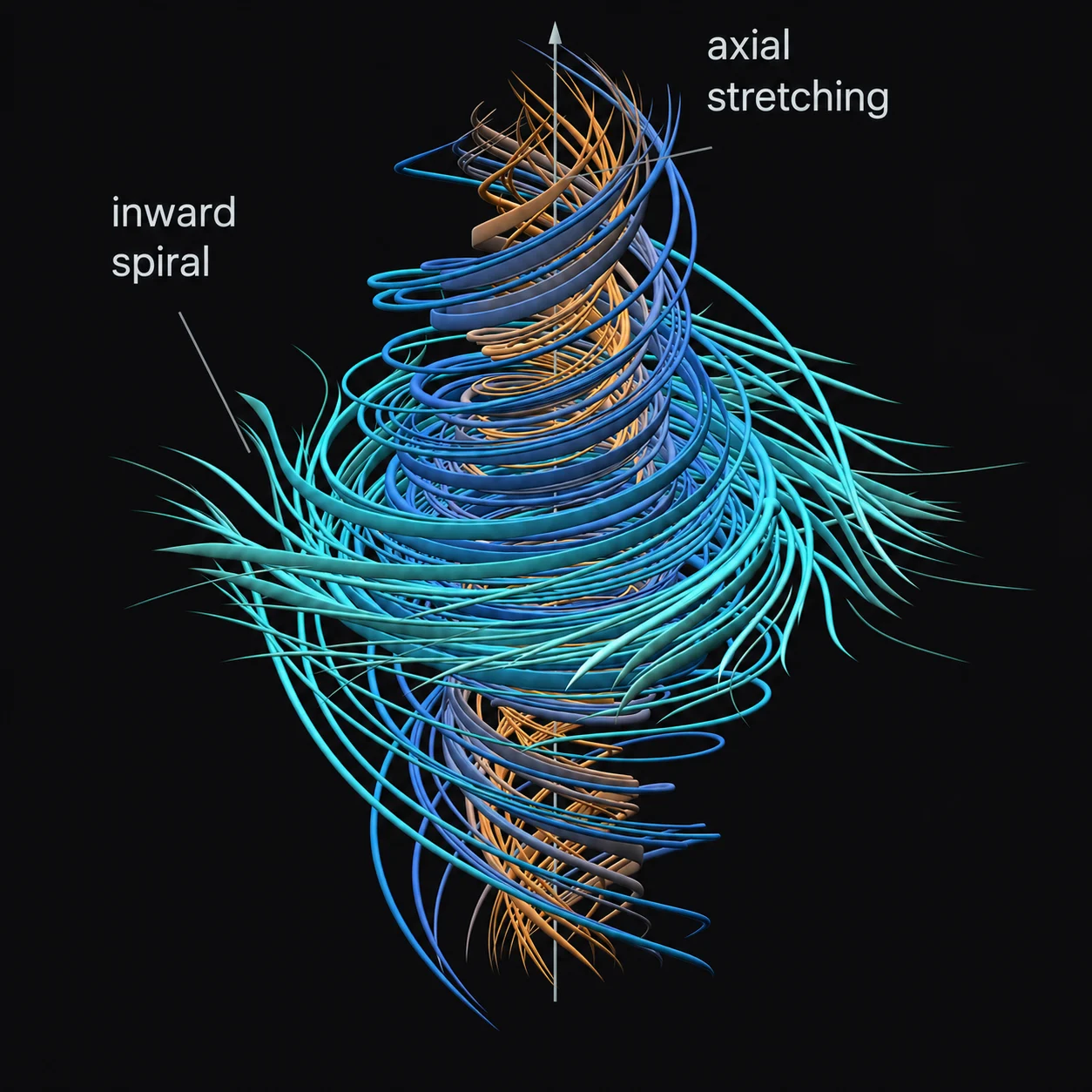
OpenAI Navier Stokes Problem
The Navier–Stokes equations describe how fluids move and are used in aircraft design, weather forecasting, and blood flow research. The open question has been whether those equations break down under certain smooth starting conditions, with fluid speeds growing without bound. A resolution would settle a problem that has remained open since Jean Leray’s work in 1934 and was named a Millennium Prize Problem in 2000.
The result, according to OpenAI, is a disproof: an initially smooth fluid at rest with a smooth external force can form a singularity while its energy remains finite. The solution is described as a vortex that spirals inward and elongates “like spaghetti,” with acceleration, pressure gradients, momentum transfer, and viscosity terms canceling precisely.
OpenAI said the model behind the work is “significantly more capable than GPT‑6 Astra” and is still in training. The company began the effort on September 1 after hearing rumors that two Millennium Prize problems had been resolved. Coordinating agents powered by the model worked on the problem for about 88 hours, and the group that produced the proof involved on the order of 10,000 concurrent agents. Lean verification took another 17 hours using GPT‑6 Astra.
OpenAI also said it does not intend to claim the Millennium Prize for the result. It acknowledged concurrent work by Levent Alpöge of Anthropic and NYU mathematician Tristan Buckmaster on a related forced Euler problem, and said the proofs and precise results differ.